
The Legend of the "Flying Z": The Gibson Thunderbolt Mystery

In the world of vintage guitars, stories of rare prototypes and "lost" designs are common, but few are as audacious or entertaining as the tale of the Gibson Thunderbolt (often called the Flying Z).

What started as a clever prank eventually blurred the lines between fiction and reality, involving rock legends, custom builders, and even Gibson’s own Custom Shop.
The Ultimate April Fool’s Gag
The mystery began in April 1992, when the UK’s The Guitar Magazine featured a double-page spread on a "newly discovered" prototype from the late 1950s. Designed by the legendary Ted McCarty, the Thunderbolt was presented as the missing link between the Flying V and the Explorer.
The design was striking: a semi-transparent cherry mahogany body shaped like a massive "Z," complete with a mirrored tailpiece. The article even announced an upcoming auction for the instrument. However, the date of the auction—April 1st—was the only clue many readers needed to realize it was a brilliant April Fool’s hoax.

From Hoax to High-End Reality
Despite the magazine’s eventual confession, the guitar had already captured the imagination of the guitar community. Because a physical instrument had actually been built for the photoshoot (likely by luthier Chris Lukasik or Tim De Whalley using Gibson parts), the "myth" became tangible.
The Thunderbolt quickly moved from the pages of a magazine to the world's biggest stages:
Rick Nielsen (Cheap Trick): Nielsen, known for his eccentric guitar collection, famously used a Thunderbolt on tour. He even had the Hamer Custom Shop create a perfect replica for him to use after the original was reportedly damaged.
Billy Gibbons (ZZ Top): The "Reverend" himself later claimed to possess one of the rare instruments.
International Clones: Japanese brand Kid’s Guitars produced a small run of Korina versions in the mid-90s, while Fernandes built a modified version for Nielsen with unique inlays.
Gibson’s Official Nod
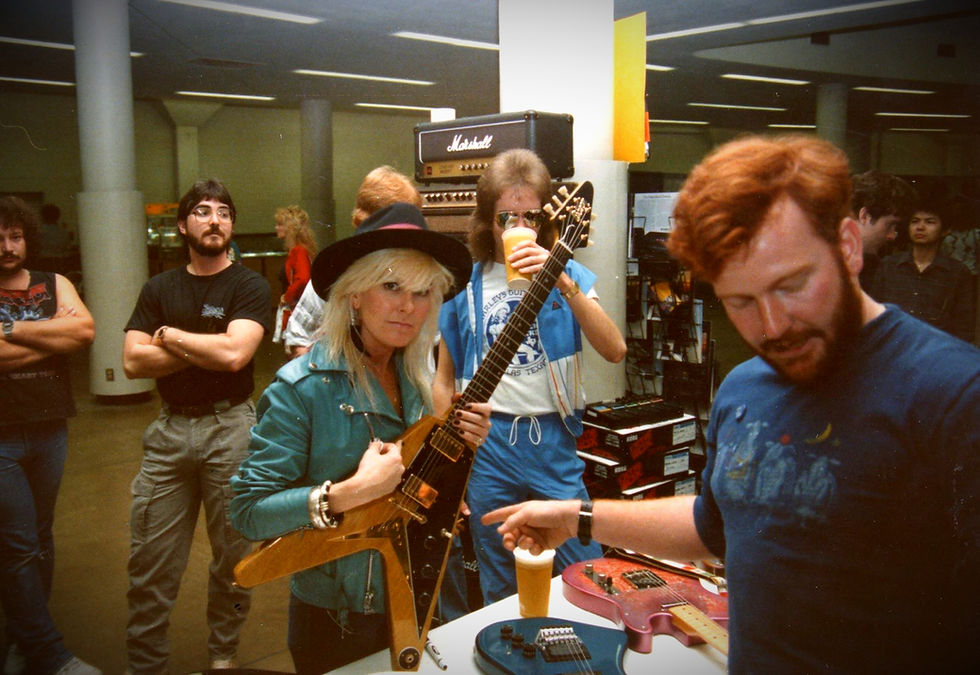
Perhaps the strangest twist in the saga is that Gibson eventually made the fake "real." In 1999, the Gibson Custom Shop produced two official Thunderbolts for the NAMM Show—one in Korina and one in Cherry-finished mahogany.
While it started as a joke to poke fun at the mysticism surrounding Gibson’s "modernistic" era, the Thunderbolt earned its place in history through sheer popularity.
Fun Fact: The guitar is even mentioned in the prestigious book Gibson Electrics: The Classic Years by A.R. Duchossoir, where the author clarifies its status as an "acknowledged fake" that became a cult classic.

The Hamer Legacy
The story came full circle in 2012 when the Hamer Custom Shop produced one final official "Flying Z" in Limba wood. It served as a tribute to the long, strange journey of a guitar that was never supposed to exist, proving that in the guitar world, a good story is sometimes just as important as the wood and wires.
For more details on the history and various builds of this unique instrument, you can read the full deep dive at Accordo: Thunderbolt: the mystery of Flying Z.
Post-Script
This specific example came from Howard Leese (Heart, Paul Rogers, Bad Company) through a close friend who then passed it along to us. Recently, a forum post about the guitar revealed this specific letter about the guitar which I believe to be this one. If you note the logo in the headstock, and the mention of it in the link, Accordo: Thunderbolt: the mystery of Flying Z, it appears to be this guitar. I do not show the headstock logo in photos as I do not want to represent it as a true Gibson model...but it looks like that one!



Comments